


Why Choosing the Right Mobile App Development Company in the USA Matters
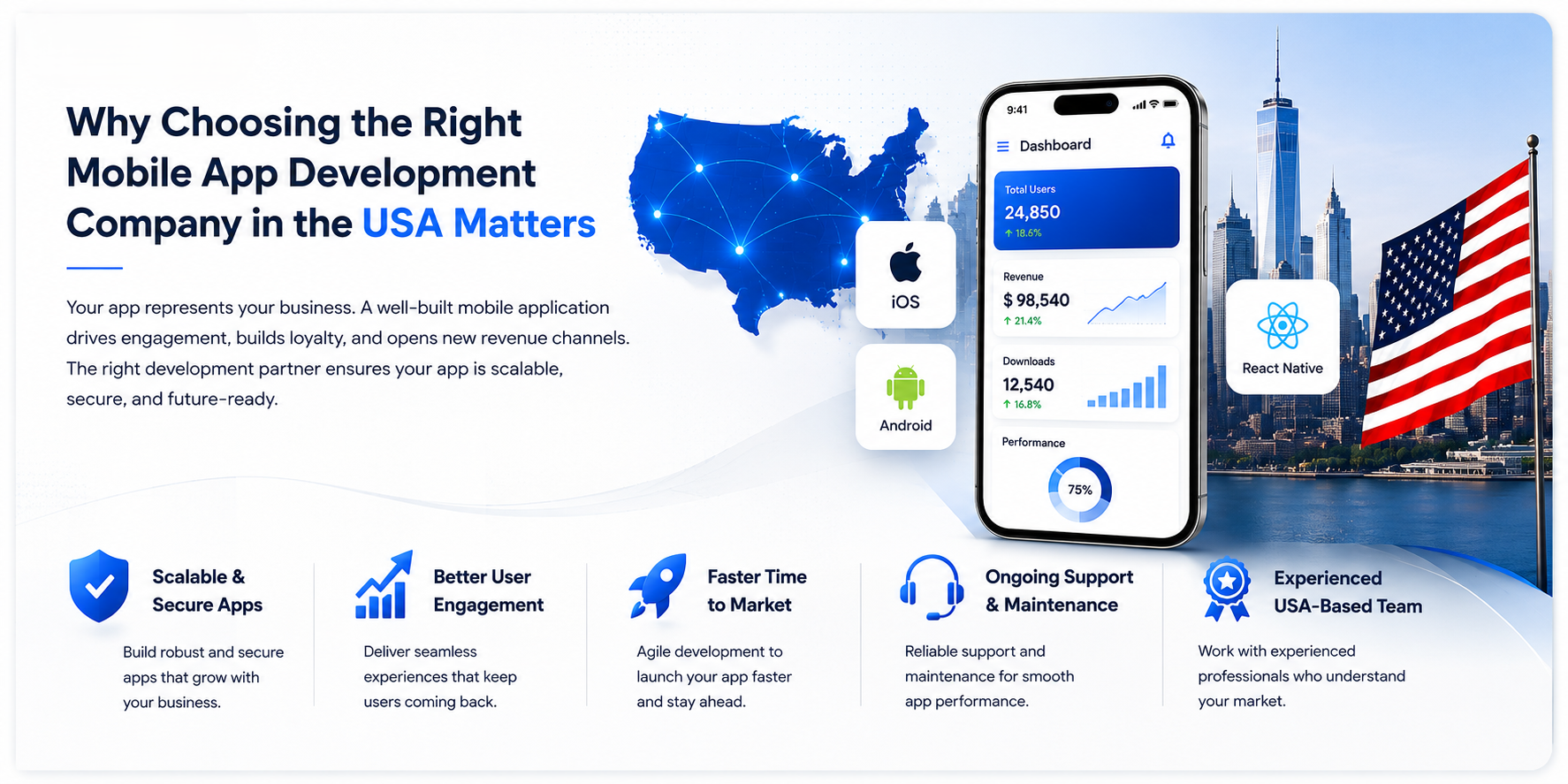
Your app represents your business to users. A poorly built application frustrates customers, increases support costs, and damages your brand. Conversely, a well-architected app drives engagement, builds loyalty, and opens new revenue channels. Many businesses underestimate the complexity involved. Mobile app development is not just about writing code. It requires product discovery, UI/UX design, backend development, API development, cloud integration, app testing, DevOps setup, App Store deployment, Google Play publishing, and ongoing app maintenance. Each phase demands specialized expertise.
Choosing the wrong partner at the start costs far more than choosing carefully upfront. Rebuilding a poorly structured app can cost two to three times the original investment. This is why your selection process matters as much as your budget.
Furthermore, the best mobile app development services in the USA go beyond delivery. They help you define the right architecture, choose the right technology, and plan for scale before development begins. That early clarity directly affects your timeline, your costs, and your product's long-term performance.
What Services Should a Top Mobile App Development Company in the USA Offer?
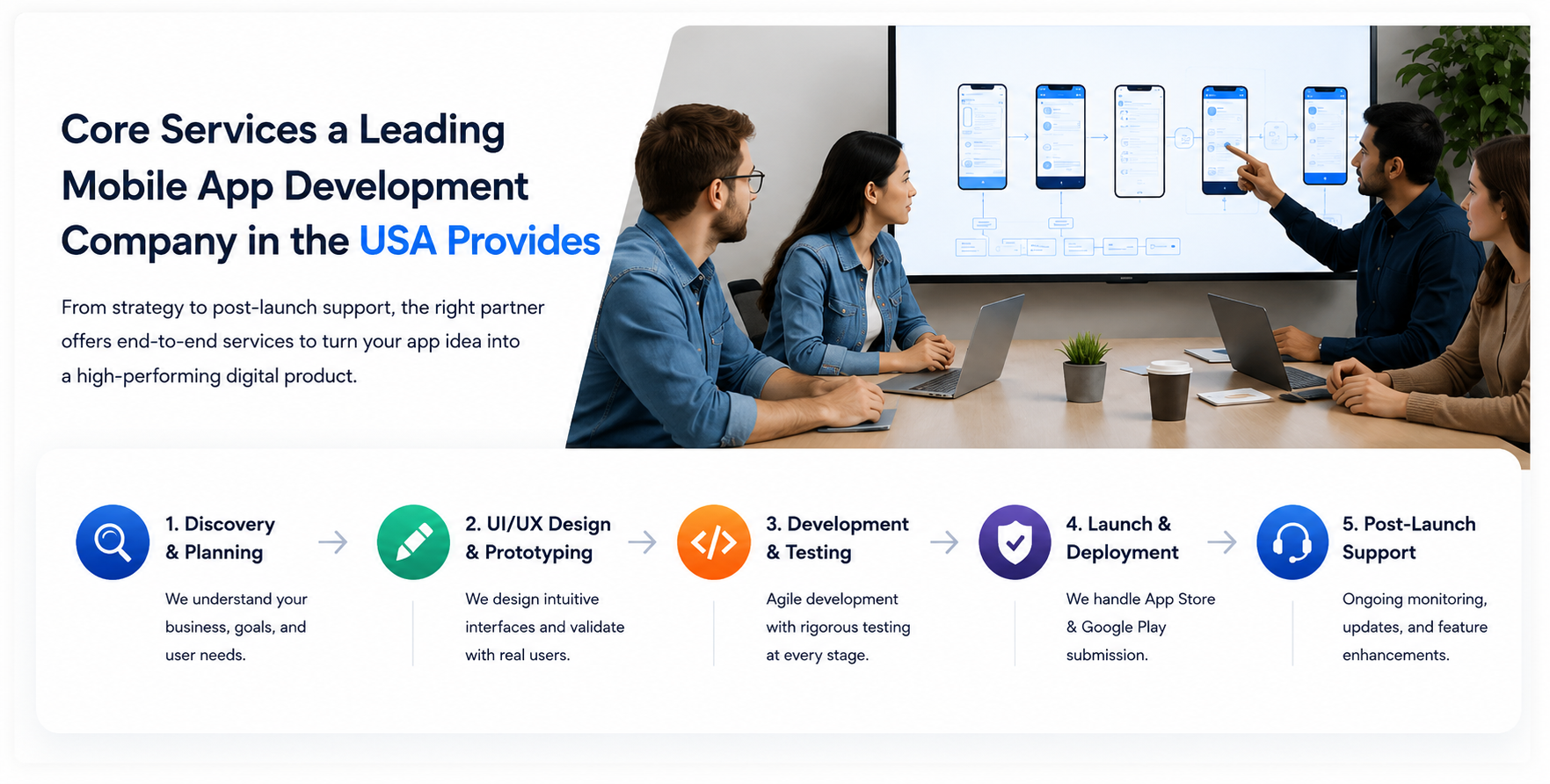
A full-service mobile app development company should cover every stage of the product lifecycle. Before you evaluate any vendor, confirm they offer the following core capabilities.
Custom Mobile App Development
Custom mobile app development means your application is built specifically for your business goals, not assembled from generic templates. A custom approach gives you full control over features, user experience, and integration with your existing systems. Custom apps also tend to scale better. They are designed around your specific architecture requirements, which means they handle increased user load without requiring a complete rebuild. For startups and enterprises alike, custom software development is the foundation of long-term digital growth. Whether you are building business mobile solutions, mobile commerce apps, or internal business automation apps, a custom-built product scales with your needs in ways template-based tools simply cannot.
iOS App Development and Android App Development
Strong companies offer dedicated native app development for both platforms. Native iOS development uses Swift, while native Android development uses Kotlin. Native applications deliver the best performance, the deepest platform integration, and the most consistent user experience.
The right choice between Android and iOS depends on your audience. If your target users are primarily in the US, iOS often has higher engagement rates. For broader global reach, Android development is essential. Many businesses choose to launch on both platforms simultaneously using cross-platform development frameworks.
Flutter App Development and React Native Development
Cross-platform development has matured significantly. Flutter app development, developed by Google, compiles directly to native machine code and renders at 60 frames per second. React Native development, maintained by Meta, uses JavaScript and shares code across iOS and Android platforms.
Flutter is generally the stronger choice for performance-heavy applications and visual consistency. React Native suits teams with existing JavaScript expertise and projects where faster iteration matters more than frame-perfect rendering. Both frameworks reduce time-to-market compared to building two separate native apps.
For a deeper look at the differences, the Flutter vs React Native comparison published by the official Flutter team provides a solid technical breakdown.
AI-Powered Mobile Apps and Intelligent Features
Modern mobile app development increasingly involves AI integration. Features like chatbot integration, machine learning-driven recommendations, generative AI content tools, and computer vision capabilities are now practical options for production apps, not just experimental ones.
AI-powered mobile apps can personalize user experiences at scale, automate repetitive tasks, and surface insights that manual systems would miss. For businesses in FinTech, healthcare, logistics, and eCommerce, these capabilities translate directly into operational efficiency and customer retention.
MVP Development for Startups
If you are early-stage, MVP development is the right starting point. A minimum viable product lets you validate your app idea with real users before committing to full-scale custom software development. The goal is to build the smallest version of your product that delivers genuine value and generates feedback.
Good MVP development is not about cutting quality. It is about building the right features first. A structured product discovery process at the start will save you months of rework later. For startups in particular, this approach to startup app development reduces risk and preserves budget for the features that actually matter to users.
Custom App Development
Built for your business goals, not templates
iOS & Android Native
Swift and Kotlin for peak performance
Flutter & React Native
Cross-platform with single codebase
AI-Powered Features
ML, chatbots, and intelligent automation
MVP for Startups
Validate ideas before full-scale build
How Do You Choose the Best Mobile App Development Company for Your Project?
This is where many businesses struggle. Every agency claims to be the best. Here is a practical framework for evaluating your options honestly, whether you are comparing a US company vs an offshore development company, or deciding between in-house vs outsourcing app development.
How to Evaluate Experience and Portfolio
Start with the portfolio. Look for projects in your industry or with comparable complexity. A company that has built FinTech apps understands compliance and security in ways a general agency may not. Similarly, a team experienced in healthcare app development will already know HIPAA requirements.
Pay attention to the results, not just the visuals. Did the app reach significant user numbers? Did it solve the client's business problem? Case studies with measurable outcomes are a more reliable signal than polished screenshots.
Weapplinse Technologies, for example, helped the Helbiz urban mobility platform achieve over 10 million app downloads and a 4.8-star rating. That kind of outcome reflects both technical execution and product thinking.
What Tech Stack Should a Mobile App Development Company Use?
A reliable company uses a modern, well-supported technology stack. For mobile, look for experience with Swift, Kotlin, Flutter, and React Native. On the backend, Node.js, Laravel, and Python are solid choices. Cloud infrastructure should run on AWS, Google Cloud, or Microsoft Azure.
Avoid companies locked into a single framework regardless of the project requirements. The best partners select the right tools based on your goals, not on what is easiest for their team. A thoughtful approach to app architecture and scalable mobile apps from the start protects your investment as your user base grows.
How to Assess Communication and Development Process
Transparency during development matters as much as technical skill. Ask prospective partners how they handle project updates, scope changes, and blockers. Agile development with regular sprint reviews, including structured agile sprint planning, gives you visibility throughout the build.
Look for dedicated project managers, not just developers. A team that communicates proactively and keeps you informed at each milestone is far less likely to miss deadlines or deliver surprises at launch.
Why Post-Launch Support and App Maintenance Should Be Non-Negotiable
Your app does not stop needing attention after launch. Bugs appear. User behavior changes. Operating systems update. Performance degrades under load. A reliable mobile app development partner provides structured app maintenance, app performance optimization, and feature development after the initial release.
Before signing any contract, confirm that post-launch support is included and clearly defined. This protects your investment and keeps your users engaged over time.
Review Portfolio & Case Studies
Look for measurable outcomes in your industry, not just polished screenshots.
Evaluate Tech Stack
Confirm experience with Swift, Kotlin, Flutter, React Native, and modern cloud platforms.
Assess Communication
Agile development with sprint reviews and dedicated project managers.
Confirm Post-Launch Support
App maintenance, performance optimization, and ongoing feature development.
Flutter vs React Native: Which Is the Better Framework for Your App?
This is one of the most common questions businesses ask before starting development. The honest answer is that both frameworks are production-ready, and neither is universally better. Understanding this comparison is one of the most useful steps you can take before you hire mobile app developers in the USA.
Choose Flutter if:
- Your app requires complex animations or custom UI components
- You want consistent performance across iOS, Android, and web
- You are building a new product with no existing JavaScript codebase
Choose React Native if:
- Your team has strong JavaScript expertise
- You want to share code with an existing web application
- Faster iteration speed matters more than maximum rendering performance
Both frameworks significantly reduce development time compared to building two separate native apps, and both outperform no-code tools when you need a scalable, production-ready product. According to the React Native documentation maintained by Meta, React Native allows developers to share roughly 90% of code across platforms. Flutter offers similar code reuse with added rendering consistency.
How Much Does Mobile App Development Cost in the USA?
Cost is often the first question, but it should be the third or fourth. Understanding scope, complexity, and technology first makes cost estimates far more meaningful. That said, here are realistic ranges based on project complexity:
Simple MVP or basic app
3 to 6 weeks
Mid-complexity app with custom features
2 to 4 months
Enterprise mobile app with integrations
4 to 9 months
Several factors affect mobile app pricing: the number of screens, the complexity of backend logic, third-party API integrations, compliance requirements (HIPAA, CCPA), and whether you need both iOS and Android versions simultaneously. Using Flutter or React Native for cross-platform development can reduce costs by 30% to 40% compared to building two separate native apps. This makes cross-platform development particularly well-suited for startups and businesses with defined budgets. It is also one of the most effective ways to reduce app development cost without compromising on quality or performance.
Why Weapplinse Technologies Is a Trusted Mobile App Development Company in the USA
Weapplinse Technologies is a full-cycle digital product engineering company serving startups, mid-market businesses, and enterprise clients across the United States. With over 12 years of experience, 500+ projects delivered, and a 100% client retention rate, Weapplinse brings both technical depth and business judgment to every engagement. The company provides end-to-end mobile app development services including product discovery, UI/UX design, iOS and Android development, Flutter and React Native development, backend and API development, cloud integration, quality assurance, DevOps, CI/CD pipeline setup, and ongoing app maintenance. This makes Weapplinse a strong fit for businesses seeking an enterprise mobile app development company as well as those needing an affordable mobile app development company for early-stage products.
Weapplinse serves clients across major US cities. If your business operates in a specific region, dedicated local service teams are available:
You can also find Weapplinse Technologies on Google Maps to connect with a local representative.
The development process at Weapplinse follows a structured workflow:
- Requirement gathering
- UI/UX design
- Prototype
- Development
- Quality assurance
- Deployment
- Ongoing support and maintenance
Each phase is transparent and collaborative, with dedicated project managers keeping clients informed throughout.
Their ability to effectively communicate technical requirements, proactively participate in the discussion, and deliver high-quality work makes it very easy and productive to collaborate with them.
— Franz Hinterkoerner, Co-Founder at SenecaMobile App Development Across Key US Cities: What to Expect Locally
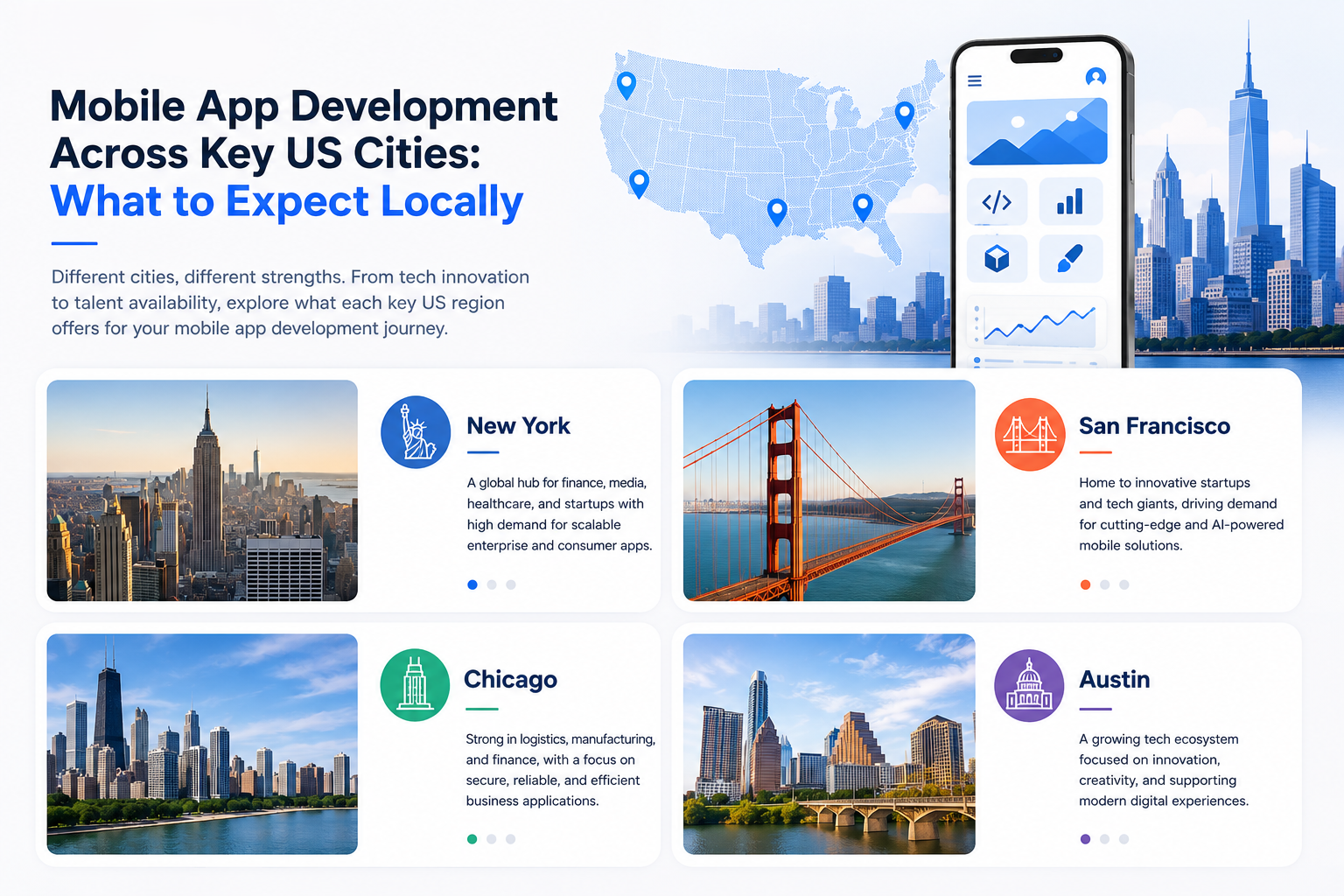
The US market for mobile app development varies by city. Each region has its own industry concentrations, talent pools, and business expectations.
Mobile App Development in New York
New York businesses tend to operate in fast-moving industries: FinTech, media, healthcare, and enterprise SaaS. Apps built for the New York market often require strong compliance handling (HIPAA, CCPA), deep API integration with existing enterprise systems, and high availability under peak traffic. The Weapplinse New York team specializes in these requirements.
Explore New York services →Mobile App Development in California
California's technology ecosystem spans consumer apps, SaaS platforms, eCommerce, and AI-powered products. Businesses in this region typically prioritize scalable architecture, rapid iteration, and strong product design. The Weapplinse California practice serves both early-stage startups and established enterprises across the state.
Explore California services →Mobile App Development in Chicago
Chicago's business landscape is rooted in logistics, finance, manufacturing, and professional services. App development in this market frequently involves complex integrations with legacy systems, supply chain tools, and enterprise platforms. The Weapplinse Chicago team brings that domain expertise to every engagement.
Explore Chicago services →Mobile App Development in Atlanta
Atlanta is one of the fastest-growing technology hubs in the Southeast. Demand spans healthcare, real estate, fintech, and retail. The Weapplinse Atlanta office supports local businesses with the same full-cycle development capabilities available nationwide.
Explore Atlanta services →Start Your Mobile App Development Project with Confidence
Choosing a mobile app development company is not just a technical decision. It is a strategic one. The team you select will shape your product architecture, influence your time to market, and determine how well your app performs under real-world conditions. If you are still exploring your options, start by defining your core requirements: the problem your app solves, the platform your users prefer, and the features that need to be present at launch versus those that can come later. That clarity will make every conversation with a development partner more productive. It also helps you compare options meaningfully, whether you are weighing a US-based partner against an offshore team, evaluating Flutter vs React Native, or deciding whether to start with an MVP or go straight to a full build.
When you are ready to move forward, Weapplinse Technologies offers a free consultation to review your requirements, assess your technical options, and provide a transparent project estimate. With over 12 years of experience in mobile app development services across the USA, the team is ready to help you build something that lasts.
Frequently Asked Questions About Hiring a Mobile App Development Company in the USA
The best mobile app development company for your project depends on your industry, budget, and technical requirements. Prioritize companies with a strong portfolio in your sector, a proven development process, and clearly defined post-launch support.
Weapplinse Technologies has a track record of 500+ delivered projects, 100% client retention, and 12+ years of experience across iOS, Android, Flutter, React Native, and AI-powered mobile app development.
For startups, the key criteria are experience with MVP development, familiarity with agile sprint planning, and flexibility as requirements evolve. Look for teams that offer a structured product discovery phase before development begins. This reduces wasted effort and helps you validate your app idea before committing to full-scale development. If you are deciding between building in-house vs outsourcing app development, outsourcing to a dedicated partner typically gets you to market faster with a more complete team from day one.
Most apps take between 3 and 6 months from discovery to launch. Simple MVPs can be completed in 6 to 10 weeks. Complex enterprise mobile applications with custom integrations, real-time data systems, and multi-platform deployment typically take 6 to 9 months or more. Timeline depends on the scope defined during the discovery phase.
Understanding this upfront is one of the clearest advantages of working with an experienced mobile app development company.
If your primary users are in the United States and you are targeting a consumer audience, iOS development generally delivers higher engagement. For broader reach or enterprise distribution on Android devices, start with Android development or build cross-platform simultaneously using Flutter. Cross-platform development covers both with a single codebase and typically costs 30% to 40% less than two native builds, making it a practical answer to the question of how to reduce app development cost.
Yes, in most cases. Flutter uses a single codebase for both iOS and Android, which reduces development hours significantly. For businesses comparing Flutter vs native development, Flutter is typically 30% to 40% more cost-efficient while delivering near-native performance. It is a particularly strong option for startups and businesses with defined budgets. You can read more in the Flutter vs React Native section above.
Outsourcing to a dedicated mobile app development company gives you immediate access to a full team: iOS developers, Android developers, UI/UX designers, backend engineers, QA specialists, and project managers. Building that team in-house takes months and requires significant overhead. For most businesses, outsourcing is faster, more cost-effective, and reduces the risk of project delays caused by hiring gaps. It is also a more flexible model than hiring in-house, especially for startups that need to move quickly and adjust scope as they learn.
Ask about their mobile app development process, their experience in your industry, how they handle scope changes, what post-launch support looks like, and how communication is managed throughout the project. Request references from past clients and review their portfolio in detail. Also confirm their security practices, especially if your app handles sensitive user data. If you are evaluating a company for enterprise mobile app development, ask specifically about their experience with scalable architecture, API integration, and compliance requirements.
ROI varies by industry and application type, but businesses that invest in purpose-built mobile applications consistently report improvements in customer retention, operational efficiency, and revenue per user. Apps that personalize user experiences and reduce friction in core workflows tend to generate the strongest returns. The most important factor is building the right product, which starts with a clear product discovery process before development begins. Whether you are building a business automation app, a mobile commerce app, or an enterprise mobility platform, getting the foundation right determines your long-term results.
Native app development means building separate apps for iOS and Android using platform-specific languages. Swift powers iOS, and Kotlin powers Android. Each native app delivers peak performance and full access to device features, but it requires two separate codebases and two separate development teams. Cross-platform development, using frameworks like Flutter or React Native, lets your team write one shared codebase that runs on both platforms. The tradeoff is a modest reduction in platform-specific customization, which is rarely a problem for most business apps. For most startups and mid-market companies, cross-platform is the smarter starting point because it cuts cost, shortens timelines, and still delivers a high-quality user experience.
Start with a product discovery phase. This typically involves defining your target users, mapping out their core problems, and identifying the smallest set of features that addresses those problems. From there, you can build a clickable prototype or a lightweight MVP and test it with real users before committing to a full build. This process reduces the risk of building something nobody wants and gives you real user feedback to guide your development priorities. Companies like Weapplinse Technologies offer structured product discovery workshops as a standalone engagement before any code is written, so you can move into development with confidence.


