


Agency or In-House Team: What Is the Short Answer?
Should startups hire a mobile app development agency or build an in-house team? Startups should consider hiring a mobile app development agency when they need specialized expertise for a defined project, want to launch an MVP, or do not have an established technical team. Building an in-house team may be more suitable when the company requires continuous development, direct technical control, and long-term product ownership. A hybrid model can combine both approaches.
Key takeaways:
For example, a startup validating its first product idea may benefit from an experienced agency, while a growing technology company with continuous product development requirements may eventually benefit from an internal engineering team.
What Is a Mobile App Development Agency?
A mobile app development agency is an external company that provides professional services for planning, designing, developing, testing, and maintaining mobile applications. Depending on the project, an agency may provide a team that includes:
- Business analysts
- Project managers
- UI/UX designers
- iOS developers
- Android developers
- Flutter or React Native developers
- Backend developers
- QA engineers
- DevOps specialists
Instead of recruiting these professionals individually, a startup can work with an established development team. An agency may support the complete application lifecycle, from initial requirements and wireframes to deployment and post-launch improvements. For startups without an established technical department, this provides access to development expertise without the immediate responsibility of building an internal engineering organization.
What Is an In-House Mobile App Development Team?
An in-house development team consists of employees hired directly by a startup to design, develop, test, and maintain its application. The team works within the company’s organizational structure and collaborates closely with founders, product managers, designers, and other employees. A typical team may include:
- Product manager
- UI/UX designer
- Mobile app developer
- Backend developer
- QA engineer
- Technical lead
The exact team size depends on the product’s complexity. A startup building a continuously evolving financial application, for instance, may need internal developers who understand its business logic, integrations, security requirements, and roadmap. An in-house team provides direct access to technical resources and builds long-term product knowledge, but the startup is also responsible for recruitment, salaries, employee management, development processes, infrastructure, and ongoing training.
Mobile App Development Agency vs In-House Team: Key Differences
Before choosing an approach, understand how the two models differ.
| Comparison factor | Development agency | In-house team |
|---|---|---|
| Hiring | Work with an existing team | Recruit employees individually |
| Initial commitment | Usually project or contract based | Ongoing employment commitment |
| Technical expertise | Access to multiple specialists, depending on the agency | Depends on recruited employees |
| Project control | Shared through agreed processes | Direct internal control |
| Team scalability | Can be adjusted through the engagement | Requires recruitment or restructuring |
| Communication | Through assigned contacts and project processes | Direct internal communication |
| Development management | Often included in the engagement | Managed by the startup |
| Infrastructure | May be supported by the agency | Arranged and managed internally |
| Product knowledge | Built during the engagement | Accumulates internally |
| Long-term maintenance | Depends on the support agreement | Managed by employees |
| Recruitment responsibility | Primarily handled by the agency | Handled by the startup |
Neither model is automatically better. The right decision depends on how frequently the application needs development work and how much technical capability the startup wants to maintain internally.
Cost Comparison: Agency vs In-House Development
An agency is often more practical for a defined project with no need for a permanent development department. An in-house team may become more economical when development is continuous and funding is sufficient. Compare total cost of ownership, not just the initial quotation.
Comparing only an agency’s quotation with an employee’s monthly salary can lead to an inaccurate decision. An in-house team has additional employment and operational expenses, while an agency engagement may include several development roles within one agreed project cost.
Costs of hiring an agency
- Project discovery and planning
- UI/UX design
- Mobile application development
- Backend development
- API integrations
- Quality assurance
- Project management
- Deployment
- Maintenance and support
Costs of building in-house
- Recruitment expenses
- Employee salaries
- Benefits and statutory employment costs
- Recruitment and onboarding time
- Development equipment
- Software licenses
- Cloud infrastructure
- Project management
- Training and professional development
- Employee retention
- Replacement hiring
Understand exactly which services an agency quotation includes and which are charged separately. For an in-house team, a startup may need separate developers for iOS, Android, and backend, plus a designer and QA engineer, and must account for the time needed to manage them. For wider budget benchmarks, see our mobile app development cost guide, and for savings ideas read how to reduce mobile app development costs without compromising quality.
Time to Market: Which Approach Helps Startups Launch Faster?
Startups often need to validate an idea, show a working product to investors, or launch before a market opportunity changes.
Development agency
Faster team start- Designers, developers, testers, and project managers may already be available
- Reduces time spent recruiting a whole team
- Uses an established process for discovery, design, development, and testing
- Speed still depends on agency availability, complexity, communication, and requirement quality
In-house team
Fast once established- Can move quickly once employees are recruited and processes are in place
- Recruitment, onboarding, and technical setup can delay the start
- For an early-stage startup with no technical team, these activities become an extra project burden
Practical consideration: if the startup needs to begin development quickly and does not already have technical employees, an agency may offer a more direct starting point.
Access to Technical Expertise
Mobile application development involves several areas of expertise. A project may require:
- iOS and Android development
- Cross-platform frameworks
- Backend architecture
- Database design
- API development
- Payment integrations
- Cloud infrastructure
- Security
- Performance optimization
- Application testing
Advantages of an agency
Breadth of skillsAn established agency may provide specialists across different technical areas. This helps when a startup needs several types of expertise but lacks enough work to justify hiring every specialist permanently.
A healthcare booking app, for example, may need mobile developers, backend developers, UI/UX designers, and QA engineers, which a relevant agency can supply through one engagement.
Advantages of an in-house team
Depth of product knowledgeAn internal team can develop deep knowledge of the product and its architecture, valuable when the application has specialized business logic or needs frequent technical decisions.
However, startups must recruit and retain people with the right skills, and a small team may lack expertise in areas outside its regular responsibilities.
Project Control and Communication
When working with an external agency, the startup communicates through an agreed project structure. This may include:
- Project manager
- Regular meetings
- Development milestones
- Task tracking
- Progress reports
- Review sessions
- Approval processes
Set clear expectations about communication frequency, project visibility, deliverables, and change requests. An agency engagement should not mean the founder loses visibility into development.
An internal team provides more direct day-to-day access, and founders and product managers can adjust priorities through internal communication. But direct access does not automatically mean better project management: the startup still needs clear ownership, documentation, technical leadership, and a structured development process.
Flexibility and Scalability
Startups often change requirements as they learn more about customers and the market. The development model should support these changes without unnecessary operational complexity.
For startups with uncertain early-stage requirements, an agency may offer more flexibility without permanent recruitment. For businesses with a stable, continuous roadmap, an internal team may offer stronger long-term continuity.
Product Ownership and Intellectual Property
Ownership matters regardless of which model you choose. Agreements should clearly define ownership of:
- Application source code
- UI/UX designs
- Database structures
- Technical documentation
- Custom-developed components
- API specifications
- Product-related assets
With an agency, the contract should explain intellectual property ownership, code handover, third-party licenses, and access to development repositories. With employees, employment agreements and company policies should address IP created during employment. Also keep access to infrastructure, source-code repositories, application store accounts, and deployment credentials.
Product ownership should never be left unclear simply because an external agency or an internal employee is responsible for development.
Security and Quality Assurance
Security and quality are essential requirements, not optional features. A poorly developed application can lead to:
Agency approach: a professional agency may have established development and testing processes, but verify the actual methodology rather than assuming every agency follows the same standards. Ask about:
- Code reviews
- Functional testing
- API testing
- Security testing
- Device compatibility
- Performance testing
- Release management
In-house approach: an internal team can stay continuously involved in code quality and security, but the startup must ensure it has sufficient QA and security expertise. Simply having developers inside the company does not guarantee better quality. In both models, quality depends on engineering practices, testing coverage, technical decisions, and accountability. For mobile security practices, see the OWASP Mobile Application Security project.
Post-Launch Support and Maintenance
Launching the application is not the end of development. After release, businesses may need:
- Bug fixes
- Operating-system compatibility updates
- Security improvements
- Performance optimization
- Backend maintenance
- API updates
- New features
- User-experience improvements
An agency may provide ongoing maintenance through a separate support agreement. Before signing, clarify response times, support hours, maintenance scope, pricing, and responsibility for urgent issues. An in-house team can manage maintenance directly, provided the startup has enough technical employees and operational resources. For apps that need frequent releases and continuous experimentation, internal technical ownership becomes increasingly valuable.
When Should Startups Hire a Mobile App Development Agency?
Hiring an agency can be suitable in several situations.
The startup has an idea but no technical team
Founders may understand the business opportunity but lack the internal resources to design and develop the application. An agency can provide the technical capabilities needed to move from requirements to a working product.
The startup wants to validate an MVP
If the goal is to test a business idea with essential functionality, an agency can help define and build a focused initial release. This lets the startup evaluate the product before committing to a larger permanent development team.
The project requires multiple technical specialists
A project involving mobile applications, backend systems, integrations, UI/UX design, and testing may require several different skills. An agency can provide these roles through one engagement.
The development requirement is project-based
Some startups need development support for a specific launch or product upgrade rather than continuous internal engineering. A project-based engagement may be more appropriate here.
The startup needs external technical guidance
An experienced development partner can help evaluate technology choices, architecture, integrations, and implementation approaches. The startup should still retain ownership of its product strategy and business decisions.
If an MVP is your goal, read MVP software development and learn when to move from an MVP to a full product.
When Should Startups Build an In-House Development Team?
An internal team can be a stronger choice when development becomes a continuous business function.
The application requires frequent improvements
If the product roadmap includes regular releases, experiments, and technical changes, internal developers can provide ongoing support.
The product has complex business logic
Some applications contain specialized workflows, proprietary algorithms, or business processes that need deep and continuous technical knowledge. An internal team can build long-term familiarity with these systems.
The startup has sufficient funding
Hiring developers involves ongoing employment and operational commitments. A startup should have enough financial resources to maintain the team beyond the initial development phase.
Technical development is a core business capability
For a technology company where software is the primary product, engineering may be central to its competitive advantage. Internal technical expertise can support long-term product development.
The company requires direct internal control
Some organizations need technical employees who work closely with internal teams, business operations, and product management throughout the day.
A Hybrid Approach: Combining an Agency With an In-House Team
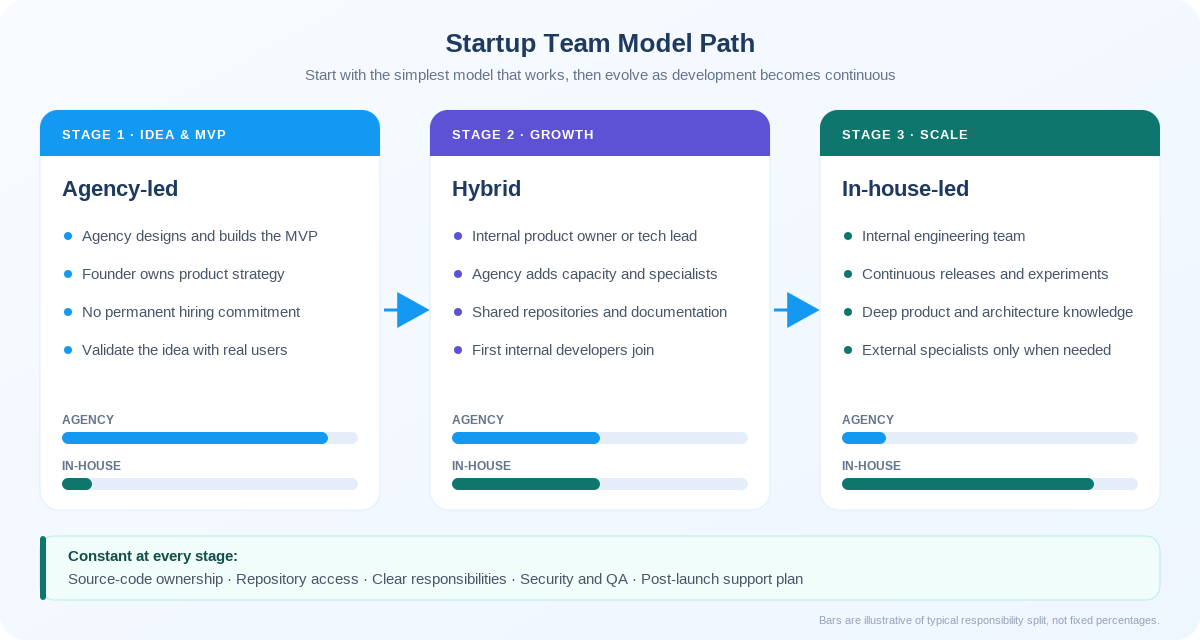
Startups do not always need to choose only one model. A hybrid approach combines internal product ownership with external development expertise.
Internal responsibilities
- Product strategy
- Business requirements
- Feature prioritization
- Customer feedback
- Product decisions
- Technical ownership
Agency responsibilities
- UI/UX design
- Mobile application development
- Backend development
- API integrations
- Quality assurance
- Deployment support
As the startup grows, it may gradually hire internal developers to manage core functionality and continuous improvements. This is useful when a startup wants strategic control while accessing specialized external expertise. Responsibilities must be clearly defined, otherwise overlapping ownership and communication gaps can create delays.
How Startups Can Choose the Right Development Model
Evaluate these decision factors before committing.
| Decision factor | Agency may be suitable | In-house may be suitable |
|---|---|---|
| Current technical team | No established team | Existing technical employees |
| Project duration | Defined development project | Continuous development |
| Funding | Limited hiring budget | Sufficient recurring budget |
| Technical requirements | Need multiple specialists | Stable internal expertise |
| Product roadmap | Early-stage or uncertain | Continuous and established |
| Development management | Prefer external project support | Have internal technical leadership |
| Product ownership | Managed through clear contracts | Managed internally |
| Long-term maintenance | Contracted support | Dedicated internal employees |
The table is a starting point, not a universal rule. Follow this step-by-step approach to apply it to your own situation.
Step 1: Check your current technical capability
Note whether you already have technical employees or leadership who can own architecture, code quality, and delivery.
Step 2: Define the product scope
List the essential features for the first release so you can compare agency quotations and hiring needs on the same basis.
Step 3: Estimate how often development work will be needed
A defined project points toward an agency. Continuous weekly releases point toward in-house or hybrid.
Step 4: Compare total cost of ownership
Compare the agency’s complete engagement cost against salaries, recruitment, benefits, infrastructure, and management time for an internal team.
Step 5: Review ownership and contract terms
Confirm source-code ownership, repository access, third-party licenses, documentation, and handover terms before work starts.
Step 6: Start with the simplest model that works
Many early-stage startups begin with an agency, then move to a hybrid or in-house model as development becomes continuous.
To define requirements before requesting quotes, use our guide on how to estimate your mobile app development scope. You may also want to read build vs buy for custom mobile apps.
A Practical Decision Framework: Three Startup Scenarios
Here is how the decision can look for three different startup situations.
Scenario A: Early-stage startup
A founder has a business idea and wants to launch an MVP. The company has limited funding and no technical employees. The startup can define essential features, establish a development budget, and build the initial application without first recruiting an entire engineering team.
Scenario B: Growing startup
The startup already has customers and a working application. It needs regular improvements, bug fixes, new features, and ongoing technical support. The decision depends on the frequency of development work and the availability of funding.
Scenario C: Technology-focused company
The company’s main product is a complex software platform that requires continuous engineering, technical research, and frequent product releases. Internal technical knowledge may be important to the company’s long-term product strategy.
Common Mistakes Startups Should Avoid
Regardless of the development model, avoid these mistakes.
How Weapplinse Can Help Startups Plan Their App
If you are planning a mobile application, Weapplinse’s mobile app development services can help you evaluate project requirements, select an appropriate technology approach, and plan the development process. We also support web application development and backend API work.
Prefer a hybrid model? You can extend your own team by choosing to hire dedicated developers, while you keep product strategy, prioritization, and technical ownership in-house.
Final Takeaway: Match the Model to Your Stage
An agency can provide access to established technical expertise, reduce recruitment responsibilities, and support a defined development project. An in-house team can offer direct control, deeper product knowledge, and continuous engineering capability. For many early-stage startups, starting with an agency is a practical way to build and validate an initial product without immediately creating a permanent technical department. As development becomes a continuous requirement, building internal capability may become more valuable, and a hybrid model can bridge the transition.
Select the development approach that matches your business stage, available resources, product complexity, and long-term objectives. Contact the Weapplinse team to discuss your project.
Related Guides & Resources
Weapplinse guides
Frequently Asked Questions
A startup should consider its budget, technical expertise, development requirements, and long-term roadmap. An agency may be suitable for building an MVP or completing a defined project, while an in-house team may be better for continuous product development and long-term technical ownership.
It can be more cost-effective for startups that need a defined project but do not require permanent developers. However, the comparison should include the agency’s complete engagement cost and the salaries, recruitment, benefits, infrastructure, and management costs of an internal team.
Yes. A development agency can help startups define the initial product scope, design the user experience, develop essential features, test the application, and prepare it for launch.
A startup may consider hiring its first internal mobile developer when it has ongoing development requirements, sufficient funding, and a clear need for continuous technical ownership.
Yes. A startup can transition to an internal team when its product and development requirements grow. Proper source-code ownership, documentation, technical handover, repository access, and infrastructure credentials make this transition easier.
Yes. A hybrid model allows startups to retain internal control over product strategy while using an external agency for specialized development, design, integrations, or testing.
Startups should review relevant project experience, technical capabilities, development processes, communication, testing, security, intellectual property terms, source-code ownership, and post-launch support.
Ownership depends on the contractual agreement. Startups should explicitly define intellectual property ownership, source-code handover, repository access, third-party licenses, and documentation before starting development.
Yes. Many development agencies offer ongoing maintenance and support. The startup should confirm the support scope, pricing, response times, and responsibilities in the agreement.
A startup with limited funding may benefit from a focused MVP and an agency engagement with a clearly defined scope. This can avoid the immediate recurring costs of recruiting an entire internal team. The approach should still account for maintenance and future development.


