


How Are AI-First Businesses Changing Traditional Business Models?
AI-first businesses treat artificial intelligence as a core part of how they design products, run operations, serve customers, and earn revenue, rather than as an add-on. This changes traditional models by moving work from manual workflows to AI-assisted processes, making customer experiences more personalized, making products more intelligent, and opening new pricing models, while people stay in charge of judgment, exceptions, and accountability.
Key takeaways
- An AI-first business designs its products, workflows, and strategy around AI from the start, instead of adding AI as an extra feature.
- The shift affects operations, customer experience, products, revenue models, decision-making, marketing, support, and growth.
- AI-first does not mean replacing employees. It means redesigning work so people focus on judgment, relationships, and exceptions.
- Start with a business problem, not a list of AI tools. Pilot one use case, measure results, then expand.
- Data quality, privacy, accuracy, integration, cost, and governance must be addressed before AI touches important workflows.
What Is an AI-First Business?
An AI-first business is an organization that considers artificial intelligence a central part of its business strategy, products, services, and operations. Rather than adding AI to an existing process only when needed, an AI-first company evaluates from the beginning how AI can improve or redesign that process.
For example, a traditional customer service company may hire more representatives as its customer base grows. An AI-first company may design a support system where AI handles routine questions, retrieves relevant information, and routes complex cases to human representatives. The objective is not necessarily to eliminate employees. It is to use AI to improve productivity, customer experiences, and the ability to handle growing demand.
An AI-first business may use:
The important difference is that these capabilities are connected to real business objectives rather than implemented as isolated experiments.
AI-First Businesses vs Traditional Businesses
Both can use many of the same technologies. The main difference is how they approach business design and decision-making.
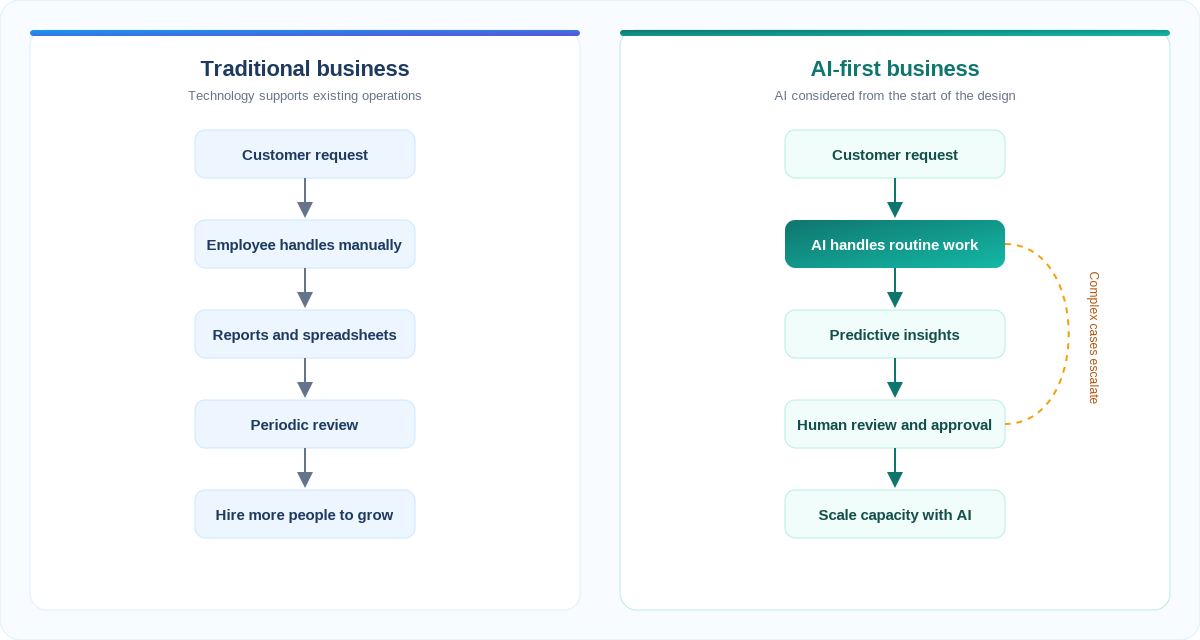
| Business area | Traditional approach | AI-first approach |
|---|---|---|
| Business strategy | Technology supports existing operations | AI is considered during business planning |
| Customer support | Primarily handled by human representatives | AI assists with routine requests and human escalation |
| Marketing | Campaigns based on predefined audience segments | AI-supported analysis and personalization |
| Decision-making | Often depends on reports and manual analysis | Uses data analysis and predictive insights |
| Product development | Features planned through conventional research and development | AI capabilities can influence product design and functionality |
| Operations | Employees manage many repetitive activities | AI automates suitable tasks with human oversight |
| Customer experience | Standardized journeys and service processes | More adaptive and personalized experiences |
| Business growth | Often requires additional people and operational capacity | AI can help increase capacity without proportional increases in some activities |
These are general patterns, not strict definitions. Traditional businesses can adopt AI-first practices, and AI-first companies still depend on people, established processes, and conventional technology.
7 Core Ways AI Is Changing Business Models
Operations Move From Manual Workflows to AI-Assisted Processes
Traditional organizations depend on employees to collect information, prepare reports, review documents, update records, and coordinate tasks across departments. Much of this is repetitive work on structured information, which AI can help reduce.
- Extract relevant information from incoming documents
- Categorize customer requests
- Summarize lengthy reports
- Identify incomplete records
- Prepare draft responses
- Route tasks to the appropriate department
- Notify employees when a case needs attention
An insurance company receives many claim documents. AI can extract details, organize documents, and flag missing information, then an authorized employee reviews the result and makes the final decision. Employees move from performing every administrative step to supervising and handling exceptions.
Business impact: Less repetitive work, more consistent processes, and more employee time for tasks that need judgment and communication.
Customer Experiences Become More Personalized
Traditional businesses group customers by age, location, or purchase history. AI-first businesses can use additional signals such as behavior and preferences. When supported by appropriate data and consent, AI can deliver more relevant experiences.
- Online stores recommending products from browsing and purchase activity
- Banking apps presenting insights from spending patterns
- Learning platforms adjusting content to student progress
- Travel apps suggesting relevant destinations and services
- Subscription platforms recommending content from viewing or listening history
A traditional eCommerce app shows the same homepage to every visitor. An AI-supported app can order product recommendations around each customer’s previous interactions. Personalization must respect privacy, data accuracy, and consent, and must allow for incorrect recommendations.
Business impact: Easier product discovery, better engagement, and stronger retention.
Products Become More Intelligent
Traditional software performs functions defined by developers. Users work through menus, forms, filters, and predefined workflows. AI changes that interaction.
- Natural language search
- Intelligent recommendations
- Automated document analysis
- Predictive notifications
- AI-assisted content creation
- Conversational interfaces
- Context-aware assistance
A project management app lets users create tasks and track deadlines. An AI-enabled version can also summarize progress, flag schedule conflicts, and draft task descriptions. A mobile banking app can explain spending patterns or find transactions through natural language queries. Add AI only where it solves a genuine user problem, not to follow a trend.
Business impact: The product shifts from a set of predefined functions to a system that assists users based on their requests and context.
Decision-Making Becomes More Data-Driven
Traditional decisions rely on experience, historical reports, spreadsheets, and periodic reviews. These remain valuable, but may be too slow when information changes quickly. AI can help analyze data, find patterns, and prepare forecasts.
- Retailers analyze sales trends to support inventory planning
- Manufacturers use equipment data to spot possible maintenance needs
- Logistics companies evaluate delivery patterns and delays
- Financial organizations use models to support risk analysis
- Marketing teams compare campaign performance and audience trends
A retailer that reviews sales reports monthly can use AI-supported analytics to notice demand changes more often and highlight products needing attention. AI predictions are not guaranteed outcomes: results depend on data quality, model performance, business conditions, and human interpretation.
Business impact: Managers get useful information faster and can make better-informed decisions.
Marketing and Sales Move Toward Intelligent Engagement
Traditional marketing relies on predefined segments, campaign schedules, and manual analysis. AI-first businesses use data and AI-supported systems to find potential customers, communicate with audiences, and evaluate campaigns.
- Generate initial marketing content for human review
- Analyze customer feedback and common questions
- Identify patterns in customer engagement
- Support lead prioritization
- Personalize product recommendations
- Summarize sales conversations
- Prepare follow-up suggestions for sales teams
A software company receives enquiries with different requirements. An AI-supported workflow can organize them by industry, requested service, and project stage, and the sales team reviews and prioritizes follow-up. AI should support the sales process, not make important commercial decisions without controls, and generated content must be checked for accuracy, originality, privacy, and brand consistency.
Business impact: Faster lead handling and better-informed sales and marketing, with people still accountable for commercial decisions.
Customer Support Shifts Toward Human and AI Collaboration
Support teams handle questions about account access, product features, order status, billing, and troubleshooting. AI chatbots can answer common questions from approved information. More advanced AI systems can retrieve data from connected tools and complete specific tasks when authorized.
- Understand a customer’s order-related question
- Retrieve order information from the connected system
- Explain the current order status
- Direct the customer to a support representative if the issue needs investigation
AI handles suitable routine interactions while human representatives focus on complex or sensitive cases. A chatbot mainly supports conversation, while an AI agent can be designed to complete defined tasks using tools and connected systems. Read more in our guide to AI agents vs AI chatbots for business automation.
Business impact: Faster answers for routine requests and more specialist time for the cases that need it.
Growth Becomes Less Dependent on Proportional Hiring
In many traditional models, growth requires more employees to manage more customers, transactions, documents, and tasks. AI can increase capacity in selected activities without the same proportional increase in manual work.
- Customer enquiry classification
- Knowledge-base search
- Support ticket summaries
- Report generation
- Internal documentation
- Basic data analysis
A growing SaaS company can use AI for these repetitive activities. AI does not remove the need for people: employees still manage customer relationships, review important decisions, handle exceptions, maintain systems, and improve products.
Business impact: Work is redesigned so employees can focus on higher-value responsibilities.
Personalization and recommendations are a good first area to explore. See how AI personalization improves mobile app user experience and how to build an AI-powered recommendation system. Considering autonomous workflows? Read should your business invest in AI agents.
Business Revenue Models Are Expanding
AI also influences how companies package and sell products and services. Traditional businesses commonly depend on:
- One-time product purchases
- Monthly or annual subscriptions
- Hourly service charges
- Licensing fees
- Transaction commissions
- Usage-based payments
AI creates opportunities to introduce new offerings or change existing pricing structures:
AI does not automatically create a profitable business model. Evaluate customer willingness to pay, delivery costs, operating expenses, and the value of the service.
Mobile Applications Are Becoming More Intelligent
Mobile apps give companies a direct connection to customers, which makes them a central part of the AI-first model. Traditional apps depend on fixed navigation, predefined forms, and standard features. AI can make them more responsive to user needs. Learn more about mobile app development and how intelligent functionality can be built into digital products.
| Industry | AI-enabled mobile application capability |
|---|---|
| Retail | Personalized product recommendations |
| Healthcare | Administrative assistance and information retrieval |
| Education | Adaptive learning support |
| Banking | Spending insights and transaction assistance |
| Travel | Personalized trip suggestions |
| Fitness | Activity analysis and personalized recommendations |
| Logistics | Delivery updates and operational assistance |
For example, a fitness app can analyze activity data and suggest workouts based on the user’s selected goals and progress. It should explain the limits of its recommendations and avoid presenting unverified AI-generated information as professional medical advice. Conversational and voice interfaces are common starting points: compare AI chatbots and traditional chatbots for mobile apps or explore voice AI in mobile apps. When planning an AI-powered app, consider:
- User experience
- Data protection
- API integration
- Performance
- Testing
- Ongoing maintenance
Traditional Industries Are Adapting
AI-first transformation is not limited to technology companies. Established industries are also incorporating AI into products and operations.
Challenges to Consider Before Becoming AI-First
AI offers opportunities, but adopting it without a clear strategy can create new business and technical problems. Evaluate these before making significant investments.
For governance and security guidance, review the NIST AI Risk Management Framework and the OWASP Top 10 for LLM Applications.
How Traditional Businesses Can Transition Toward an AI-First Model
Becoming AI-first does not require replacing every system or redesigning the whole organization at once. A gradual approach lets you find useful opportunities, evaluate results, and expand what works.
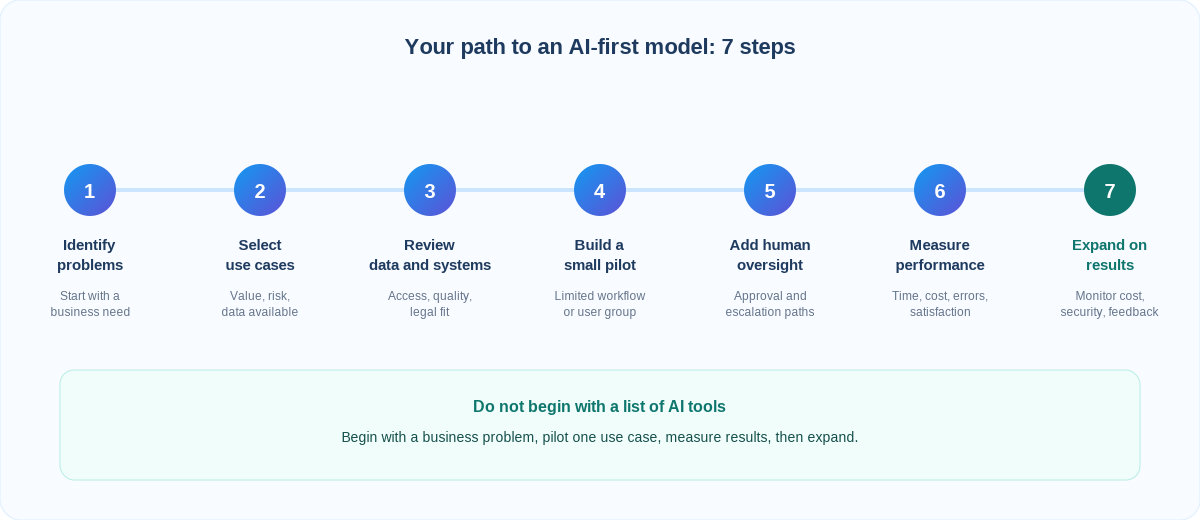
Step 1: Identify business problems
Review activities with repetitive work, slow information processing, high administrative effort, or customer experience problems. Do not begin with a list of AI tools. Begin with a problem to solve.
Step 2: Select suitable AI use cases
Evaluate options by business value, implementation complexity, available data, risk, and measurable outcomes. A customer support knowledge assistant is a more practical start than an autonomous system making important financial decisions.
Step 3: Review data and existing technology
Identify the systems, databases, APIs, and information sources needed. Check that required data is accessible, accurate, protected, and legally suitable for the intended use.
Step 4: Build a small pilot
Test with a limited workflow, user group, or process. For example, start with AI-assisted document classification before expanding to automated document processing.
Step 5: Establish human oversight
Define what AI can do independently, what needs employee approval, and what stays under direct human control. Set escalation paths for uncertain or high-risk situations.
Step 6: Measure performance
Track whether the solution improves the process using measurable indicators such as task time, cost per transaction, response time, error rates, employee time saved, customer satisfaction, AI operating costs, and task completion rate.
Step 7: Expand based on results
If the pilot delivers measurable value and runs reliably, extend it to other departments or workflows. Keep monitoring performance, costs, security, and feedback after deployment.
Useful pilot metrics include:
- Time required to complete a task
- Cost per transaction
- Customer response time
- Error and correction rates
- Employee time saved
- Customer satisfaction
- AI usage and operating costs
- Successful task completion rate
Treat the first release as a test. Our guide on when to move from MVP to a full product explains how to decide when to scale.
What Does an AI-First Strategy Look Like in Practice?
Consider a traditional online retailer with a website and mobile app, which wants to improve customer experience and operational efficiency. Its existing model includes:
- A product catalogue
- Standard search and filters
- Manual customer support
- Scheduled marketing campaigns
- Basic sales reports
- Employees handling inventory updates
| Existing process | Before | Potential AI-first improvement |
|---|---|---|
| Standard product search | Manual or standard | Natural language product discovery |
| General product recommendations | Manual or standard | Recommendations based on relevant customer activity |
| Manual support responses | Manual or standard | AI-assisted answers with human escalation |
| Manual sales reporting | Manual or standard | AI-supported analysis and summaries |
| Manual review of customer feedback | Manual or standard | Automated feedback classification |
| Basic demand planning | Manual or standard | AI-supported demand forecasting |
The company does not need to implement every capability at once. It can start with one well-defined use case, measure its impact, and expand only when results justify more investment.
AI-first transformation is not about adding the largest number of AI features. It is about redesigning business activities around useful, reliable, and measurable capabilities.
The Future of AI-First Business Models
AI will continue to influence how companies develop products, organize work, and deliver services. Several developments are likely to shape future business models:
The companies that benefit most will not necessarily adopt every new AI technology. They will understand their customers, select appropriate use cases, and build reliable systems around real business needs. For background reading, see Google Cloud’s overview of AI agents and IBM’s explanation of AI agents.
How Weapplinse Can Help You Become AI-First
Successful AI adoption needs coordination across business analysis, UX, backend engineering, AI integration, security, and QA. Weapplinse helps businesses define scope and build AI functionality through AI services and solutions and mobile app development services, with supporting web application development and API integration.
Start with one focused use case, such as a support knowledge assistant or document classification, then expand based on measured results. Need extra engineering capacity? You can hire dedicated developers. Not sure whether you need a chatbot or an agent? Read AI agents vs AI chatbots for business automation.
Final Takeaway: Start With One Real Problem
AI-first businesses are changing traditional business models by making artificial intelligence a central part of how products are developed, services are delivered, and operations are managed. The shift is visible in customer support, marketing, sales, product development, analytics, and mobile apps, and it creates opportunities for new revenue models and more efficient workflows.
Success needs more than AI tools: clear objectives, reliable data, suitable technology, security controls, employee involvement, and measurable results. For most traditional companies, the practical starting point is one process where AI can solve a real problem. Test it, measure its value, and expand based on evidence.
Planning an AI-powered product or workflow? Contact the Weapplinse team and we will help you pick the right first use case, define the scope, and plan the integrations and controls.
Related Guides & Resources
Weapplinse guides
- AI Agents vs AI Chatbots for Business Automation
- Should Your Business Invest in AI Agents in 2026?
- AI Chatbot vs Traditional Chatbot for Mobile Apps
- How AI Personalization Improves Mobile App UX
- AI-Powered Recommendation System for a Mobile App
- Voice AI in Mobile Apps
- Mobile App Development Cost in the USA (2026)
- All Weapplinse Guides
Frequently Asked Questions
A traditional business generally uses technology to support established processes. An AI-first business considers AI when designing its products, workflows, services, and business strategy. Both can use AI, but their approach to business design is different.
AI can change how businesses deliver products and services, interact with customers, manage operations, make decisions, and generate revenue. It can support personalized experiences, automated workflows, AI-enabled products, and new service offerings.
Yes. Small businesses can start with practical use cases such as customer enquiry classification, document processing, content assistance, reporting, and customer support. They should choose solutions according to budget, available data, and business requirements.
No. AI-first transformation does not automatically mean replacing employees. AI can assist with repetitive tasks and information processing, so employees can focus on work that needs judgment, creativity, communication, and decision-making.
Retail, banking, healthcare, education, manufacturing, logistics, travel, insurance, and software businesses can all explore AI-first approaches. Suitable applications depend on industry requirements, data availability, regulations, and operational needs.
Common challenges include data quality, privacy, security, integration, AI accuracy, operating costs, employee adoption, and governance. Address these areas before deploying AI in important workflows.
There is no single cost. Expenses depend on the use case, data requirements, model selection, integrations, infrastructure, security, development effort, and ongoing maintenance. A focused pilot is often a practical way to evaluate cost before a larger investment.
Identify a business problem that could benefit from AI. Evaluate its potential value, required data, implementation complexity, and risks. Then test a limited solution and measure the results before expanding.
No. Becoming AI-first means rethinking how work gets done, where decisions are made, how customers receive value, and how technology supports long-term growth. Adding more tools without that redesign does not make a business AI-first.


